USB star-LED driver
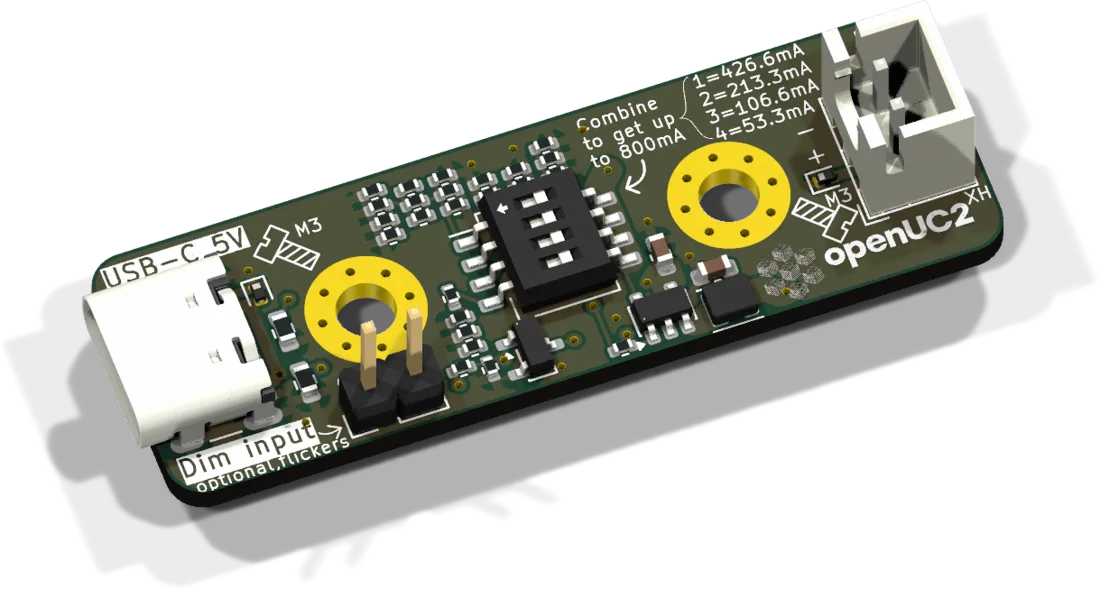
A light source for the Discovery boxes that needs nothing but a USB-C charger or power bank. It drives one high-power LED on a star-shaped aluminium PCB at a constant current that is set with a DIP switch. There is no microcontroller and no firmware.
| Current revision | Rev. A, 2026-03-28 |
| Input | USB-C, 5 V. Only power is taken, there is no data connection. |
| Driver | PAM2804, synchronous step-down, constant current |
| Output | one LED die (forward voltage up to 4.4 V), 53 to 800 mA, max. about 3.5 W |
| Sources | KiCad project · schematic PDF |
Connectors
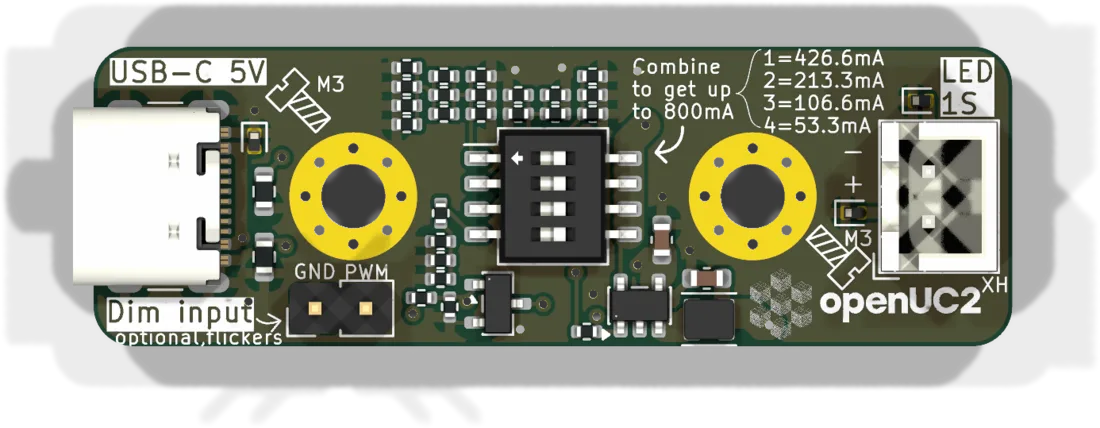
| Ref | Type | Pins | Use |
|---|---|---|---|
| J102 | USB-C | 5 V in | |
| J103 | 2 pads / terminal | LED +, LED − | star LED |
| J101 | 2 solder holes | GND, dim | optional dimming input |
Setting the current
SW101 has four switches with binary weights. The LED current is the sum of all switches that are ON.
| Switch | Adds |
|---|---|
| 1 | 426.6 mA |
| 2 | 213.3 mA |
| 3 | 106.6 mA |
| 4 | 53.3 mA |
All ON gives 800 mA, all OFF turns the LED off. Check the datasheet of your LED before going high: many small star LEDs are 350 mA parts, and at 800 mA the star needs a heatsink. A plain USB port without negotiation delivers 500 mA at 5 V, which is not enough for the upper settings. Use a charger.
Dimming
Voltage on pin 2 of J101 reduces the LED current and switches the LED off. For PWM dimming from a microcontroller use about 500 Hz. At 1 kHz and above the resolution near full brightness gets coarse.
For computer-controlled LEDs in a box, the standalone board has three of these drivers built in, dimmed by the ESP32.
Boards and LEDs: shop.openuc2.com. Questions: openuc2.discourse.group.