HoloBox - Digital Holography and Interferometry
A fully open-source learning system for optics, interferometry, and holography.
The HoloBox is a modular, open-source toolbox that brings classical and digital optics experiments into classrooms, labs, and maker spaces. Built on the openUC2 cube system, it enables hands-on experiments ranging from Michelson/Mach-Zehnder interferometry to inline digital holography and lensless microscopy. The system combines precise optical hardware, open electronics, and modern digital workflows such as Jupyter notebooks, Python image reconstruction, and AI-ready embedded cameras.
The entire project is open-source: hardware, firmware, software, and teaching materials.
What You Can Do With the HoloBox
The HoloBox enables a wide spectrum of optical experiments
Classical Optics & Interference
- Build and align a Michelson interferometer
- Explore the Mach–Zehnder interferometer
- Perform double-slit and grating diffraction
- Observe interference fringes, stability, drift, phase shifts
- Observe temperature induced variations in the Michelson Interferometer
- Reconstruct Inline Holography Microscopy/Digital Holography Microscopy (DHM) using a Raspberry Pi
- Visualize thermal expansion by heating one arm of an interferometer
Digital Holography
- Capture inline holograms using a point source and the Raspberry Pi Camera
- Reconstruct the hologram numerically using a Python-based UI or Jupyter notebooks
- Perform digital refocusing, Fourier analysis, and phase retrieval (comming soon)
- Understand the connection between physical waves and numerical propagation
Lensless Microscopy
- Image microscopic samples with/without an objective lens
- Detect microplastics, plankton, or other transparent objects
- Explore Fresnel propagation and digital reconstruction of real samples
Interdisciplinary Learning
- Combine physics with biology, environmental science, or computer vision
- Use programmable electronics (LED modulation, heaters, piezo elements)
- Learn scientific computing through interactive coding tasks
What’s Included in the Box
The HoloBox comes in two modular versions. Schools, labs, and hackers can start with the Base Set and expand later with the Digital Extension.
1. Base Set – Interferometry & Wave Optics
Includes everything needed for classical optical experiments:
- Precision openUC2 injection-molded cubes
- 50 mm optical rails & mounts
- Front-surface mirrors
- Beam splitter
- Low-cost laser module
- Screens for fringe observation
- Apertures, slits, gratings
- Worksheets / Wunderbooks
- Printed build instructions
This set enables:
- Michelson interferometer
- Mach–Zehnder interferometer
- Diffraction experiments
- Basic holography (scratch holograms)
Inline Holography
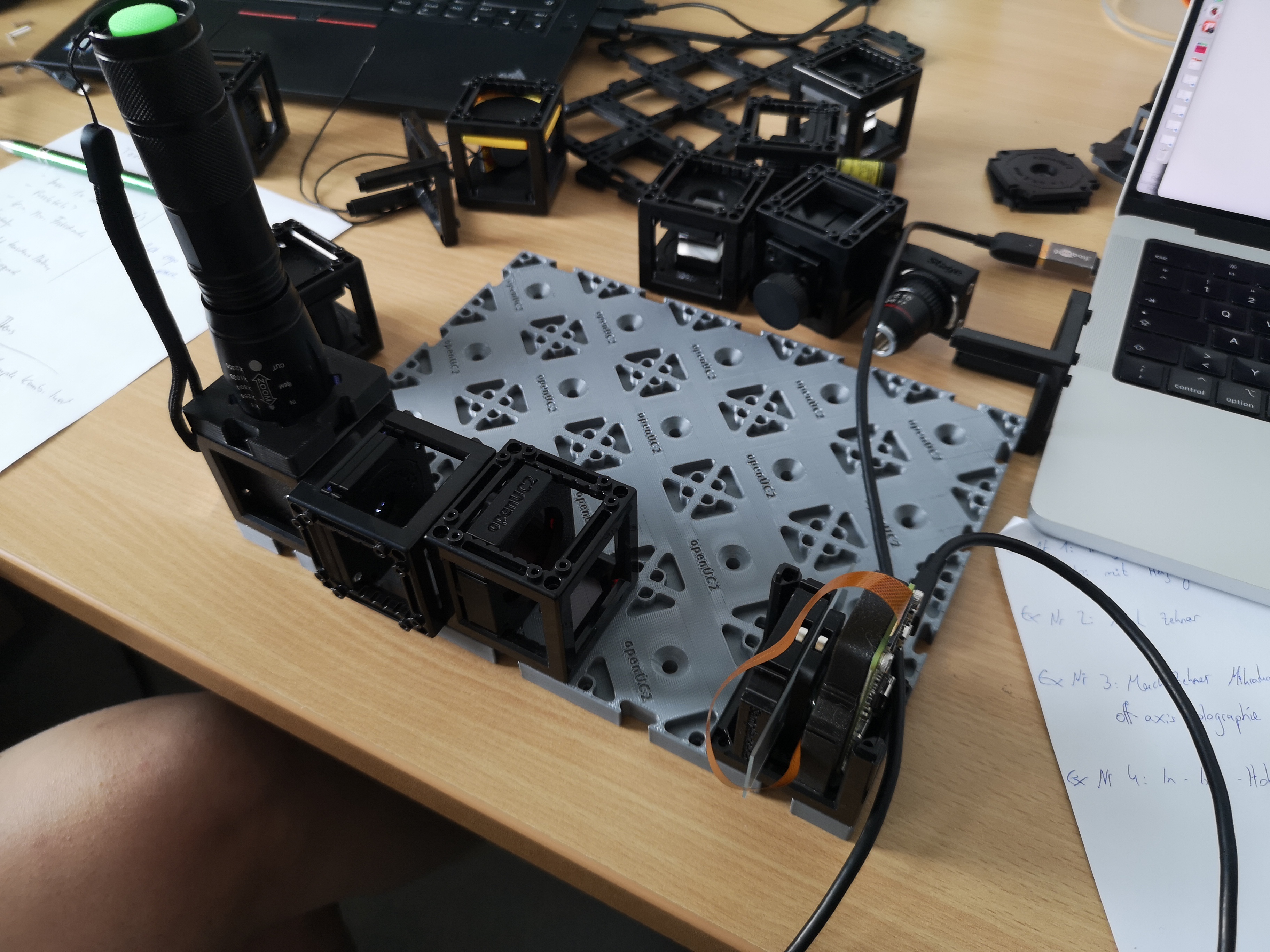
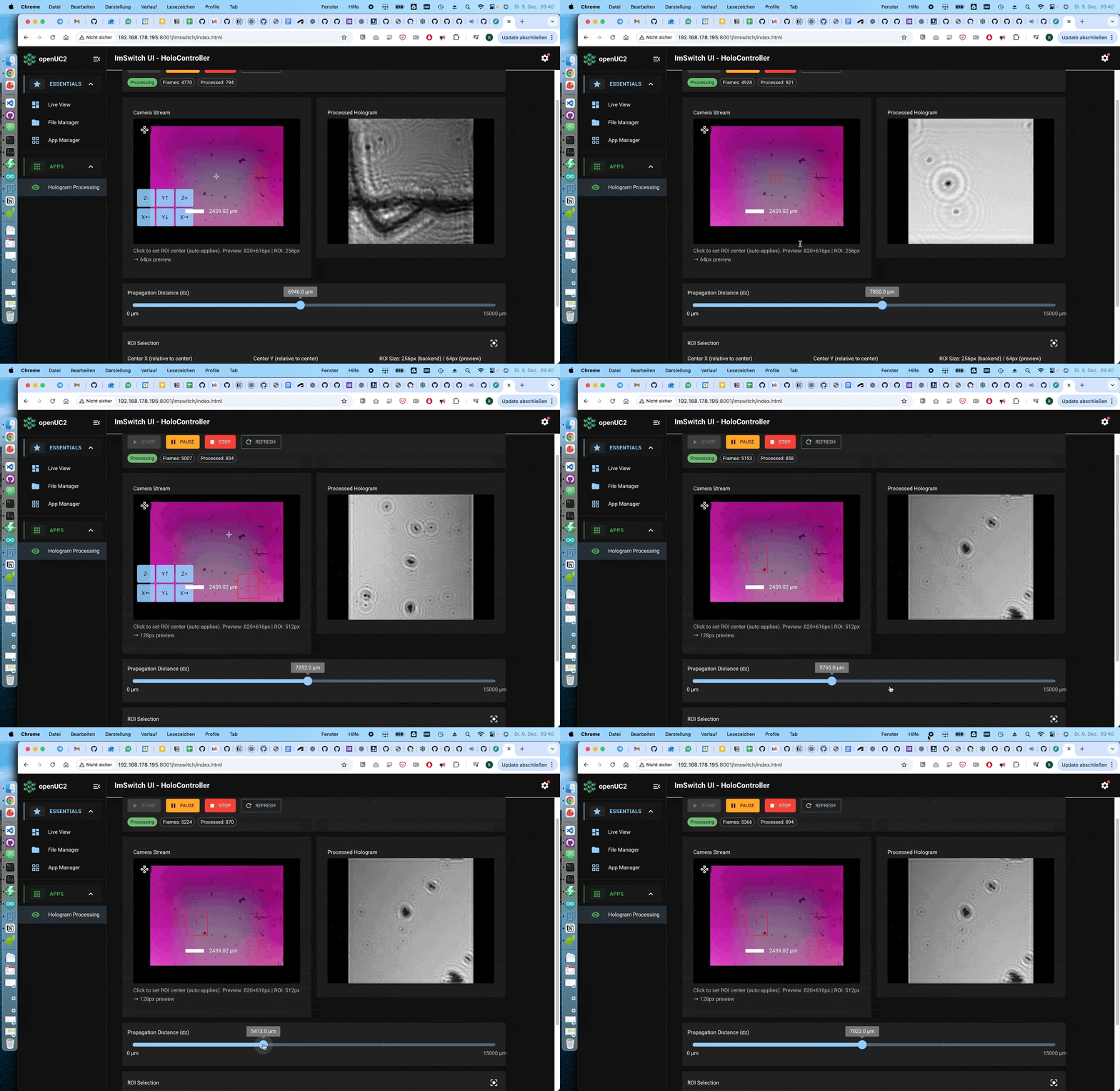
Reconstruction using the ImSwitch Inline Holography Plugin
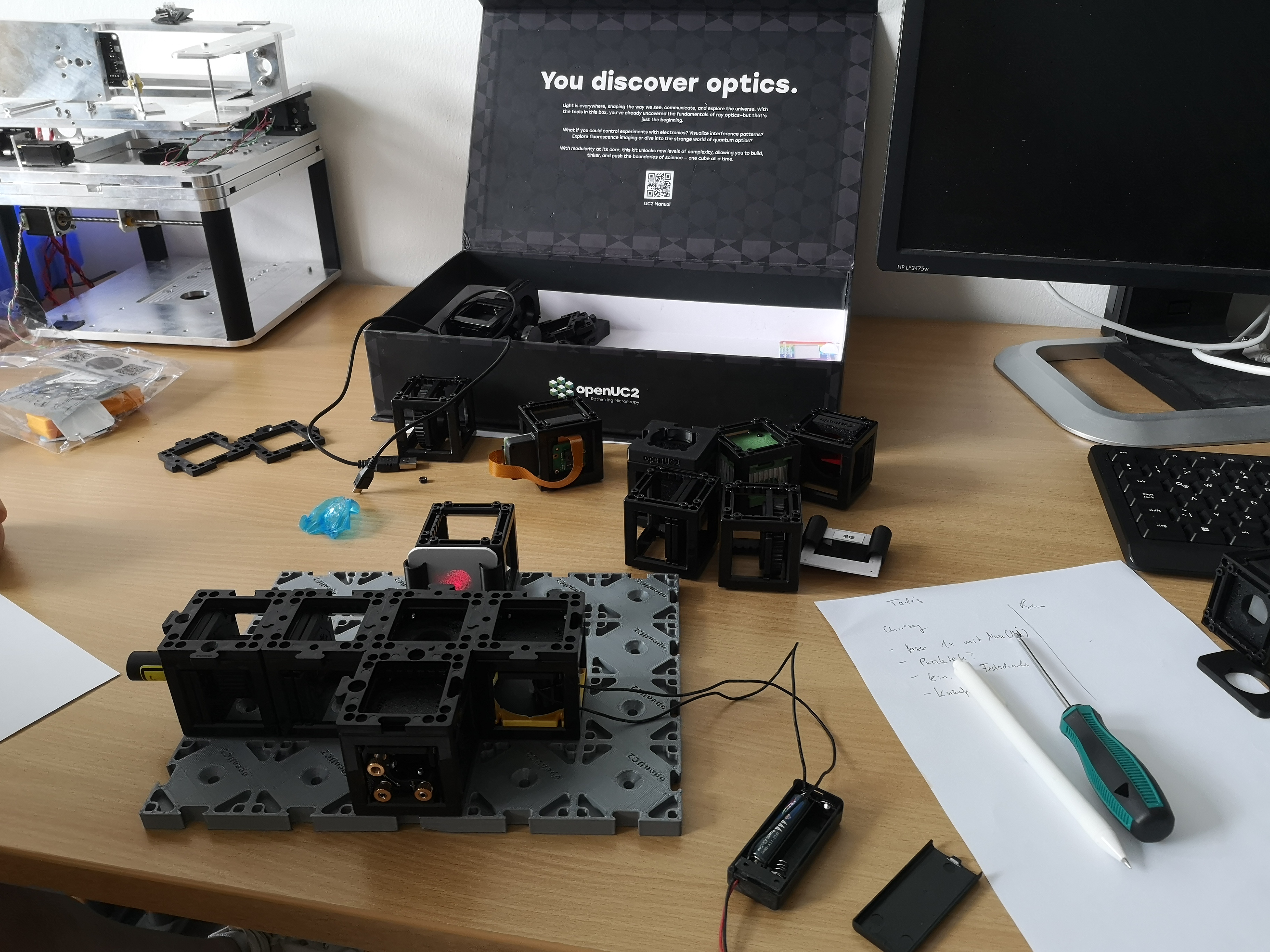
Michelson Interferometer
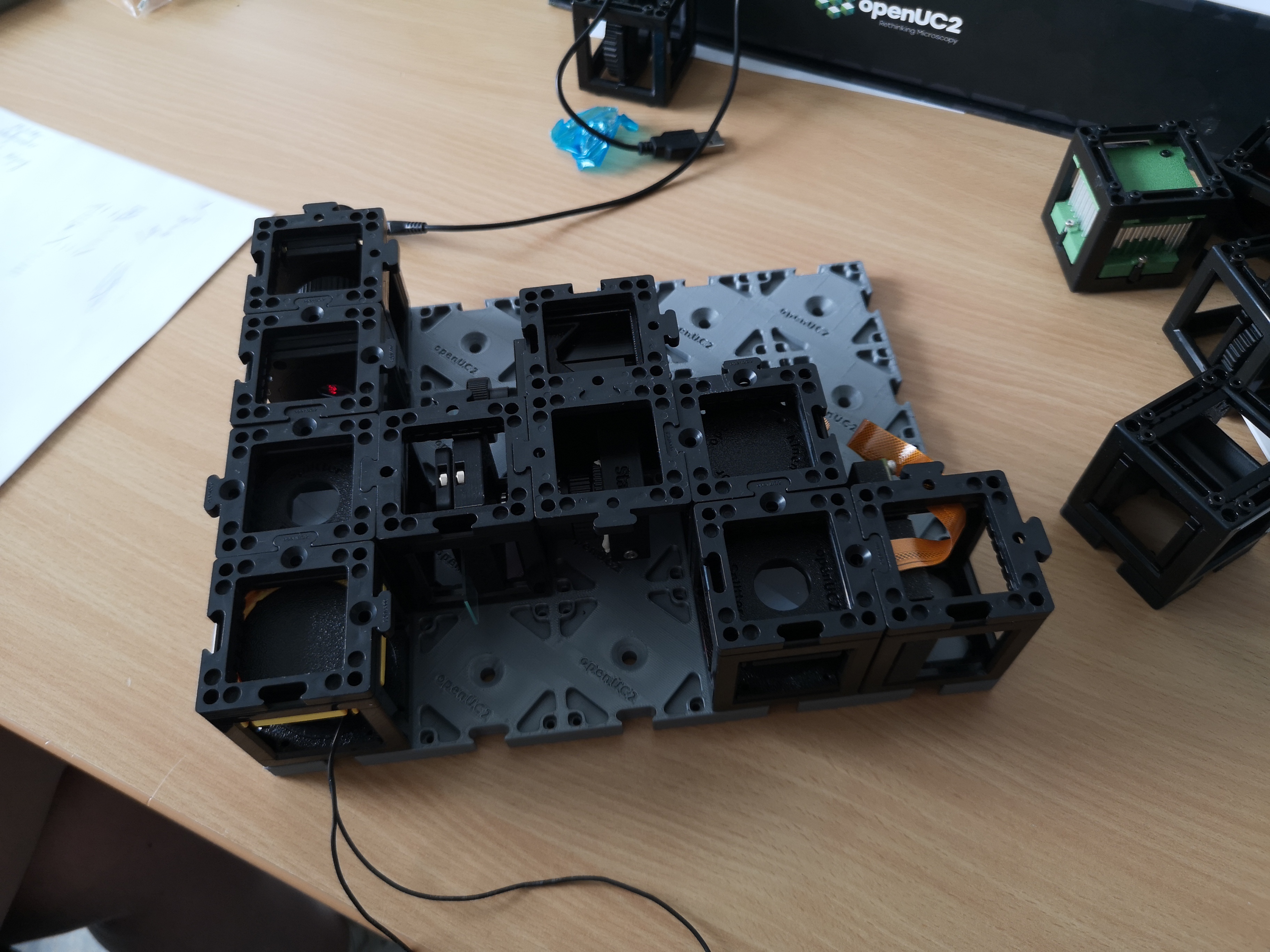
Mach Zehnder Interferometer
2. Digital Extension – Holography & Computation (deprecated)
The new computational part of the HoloBox is now integrated into the ImSwitch system. We decided to integrate a Raspberry Pi 5 overa a Raspberry Pi Nano to have better performance and capabilities.
For the legacy part, you can follow the custom Raspberry PI image here:
Adds the digital and computational layer:
-
Raspberry Pi Camera (smart camera that runs our dedicated Operating Sytsem)
-
Download the image from here and flash to the SD card https://github.com/openUC2/TechnicalDocs-openUC2-HoloBox/releases/
-
Electronics module for:
- LED control
- Thermal/piezo phase shifting
- Triggering and syncing
-
Python and Jupyter notebook tutorials
-
Digital reconstruction workflows
-
Sample experiments (microplastics, plankton, etc.)
This set enables:
- Inline holography
- Hologram reconstruction
- Lensless microscopy
- Computational imaging
- Integration into coding classes
Modularity & Open-Source Philosophy
The HoloBox is fully modular and open:
- All CAD files are openly published (STL/STEP)
- Parts can be replaced or extended via 3D printing
- Supported by a growing openUC2 community
- Compatible with the UC2 miniBOX, coreBOX, and Quantum MiniLabs
- Designed for repairability and long-term use
- Firmware, software, workflows, and notebooks are open source
The goal: Make advanced optics accessible, affordable, and hackable.
Getting Started
-
Get your kits from openUC2 Write us a mail: purchase@openuc2.com - STP files will be shared once we're fully done with development
-
Run your first experiment Choose between Michelson, Mach-Zehnder, diffraction, or holography.
-
Connect the Raspberry Pi Camera (optional) Start capturing digital holograms or real-time interference patterns. Connect to the Wifi Hotspot (password:
holobox123) and open the website http://192.168.4.1 -
Open the Webiste Learn how to:
- Load holograms
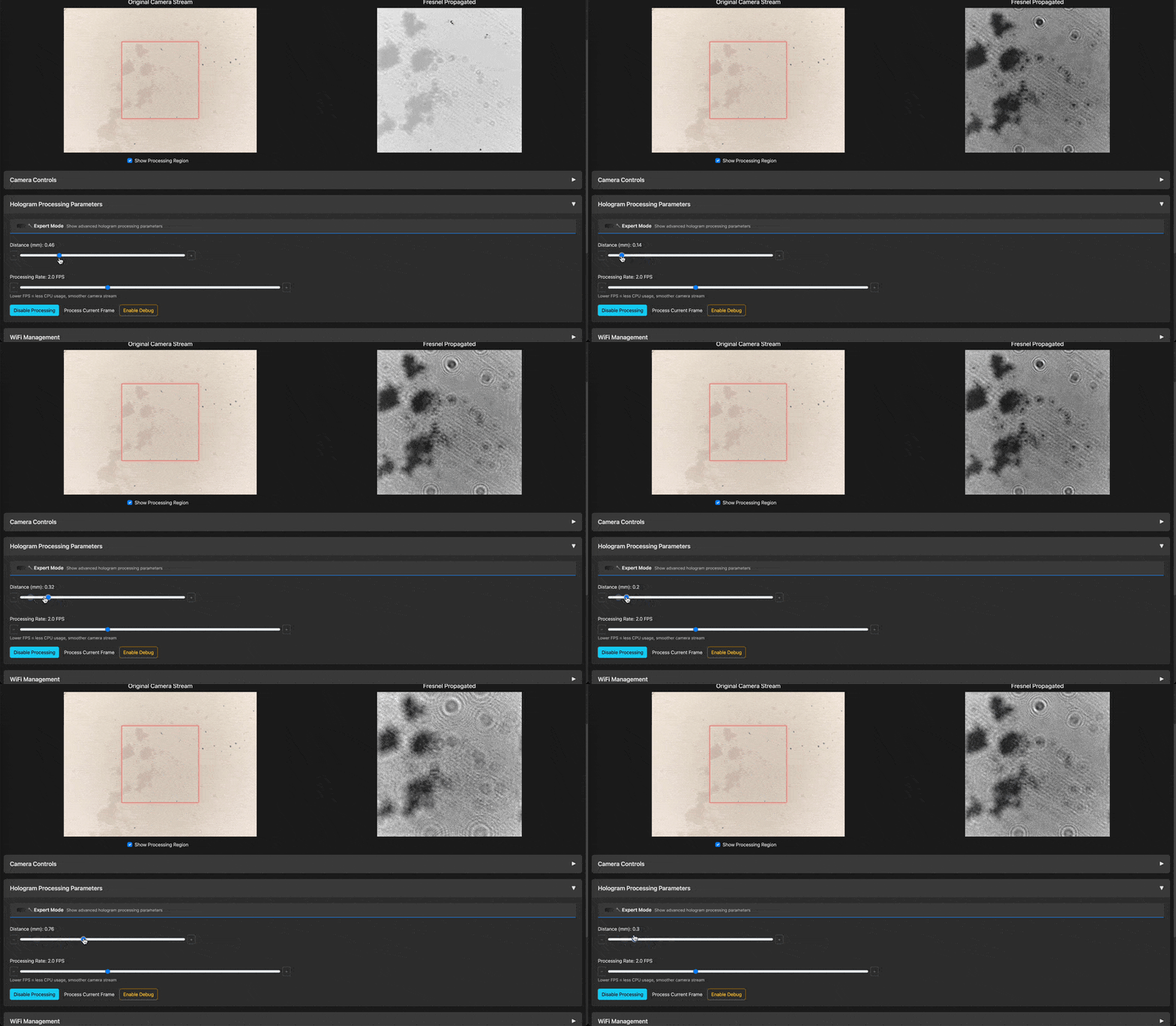
- Reconstruct using Fresnel propagation
- Perform digital refocusing
- Visualize spacetime fringes and frequencies
-
Modify & extend Print new modules, explore new samples, or write your own analysis scripts.
Documentation & Resources
Links will be added once this repo structure is finalized.
Who Is Behind the HoloBox?
The HoloBox is a collaboration between:
- openUC2 GmbH – hardware, electronics, software & production
- University of Münster – Institute for Physics Education – didactic design & teaching materials
- Supported by regional & national STEM networks
Roadmap
- Additional digital reconstruction methods
- Phase-shifting holography
- Multi-wavelength illumination
- Plugin for ImSwitch
- Extended classroom activities
- Community-submitted modules
License
All hardware, firmware, and software are released under open licenses:
- Hardware → CERN OHL / CC-BY
- Software → MIT
- Teaching materials → CC-BY