How to measure a focal length
Task-oriented. You know what a focal length is and want a number.
Converging lens (+50 mm, +100 mm): the distant-source method
The trick: light from a far-away source arrives as (almost) parallel rays, and parallel rays meet exactly in the focal point.
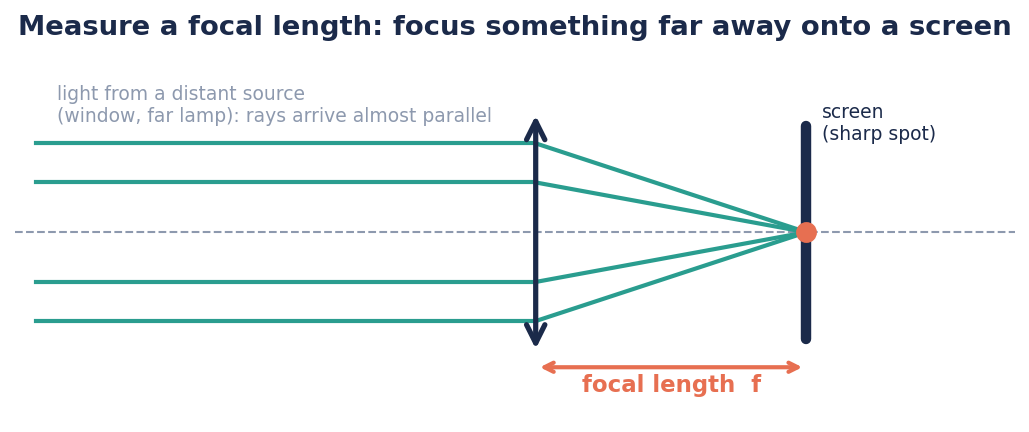
- Point the lens at something far away and bright — the window scene, or a ceiling lamp across the room. At least a few metres of distance.
- Hold a piece of paper (the "screen") behind the lens, parallel to it.
- Move the paper towards/away from the lens until a small, sharp image of the source appears (the window scene will be tiny and upside-down).
- Measure the lens-to-paper distance with the ruler. That distance is f.
Expected: ≈ 50 mm and ≈ 100 mm for the CoreBox lenses (the printed value, within a few millimetres).
Use a nearby light source instead, measure object distance and image distance for three different positions, and compute from each time. Plotting against gives a straight line with intercepts — a nice measurement exercise.
Diverging lens (−50 mm): combine it with a known lens
A diverging lens never forms an image on a screen (its focus is virtual), so measure it indirectly:
- Hold the +50 mm and the −50 mm lens directly together and repeat the distant-source method.
- For thin lenses in contact the powers add:
Zero power — the pair behaves like a flat window: no image forms at any distance. That's your proof the negative lens really has ≈ −50 mm. 3. For an actual number, pair the −50 mm with the +100 mm lens instead. Ideally the combination has mm — still diverging. Pairing it with a stronger positive lens than +50 mm would give a measurable real focus; within the CoreBox, the window-pane experiment in step 2 is the clean result.
Quick sanity check without any setup
Look through the lens at text and pull it away from the page:
- The distance where the magnified image blurs and flips upside-down ≈ the focal length of a converging lens.
- If it never flips and never magnifies → it's the diverging lens.
Related
- Light rays and lenses — what the focal length means
- From lens to projector — use the measured value